
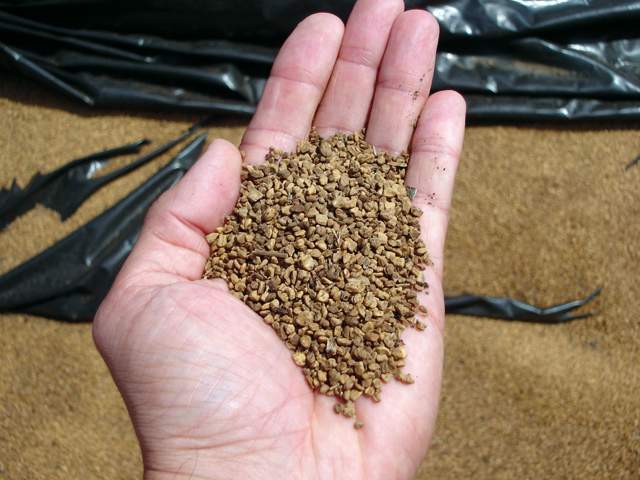
In a “interpretative note”In May 2021, the General Sub-Directorate of Circular Economy clarified that olive pits obtained through mechanical or physical methods are a biomass material from the agro-industry, natural, non-hazardous and used to generate energy without endangering human health or the environment.
Olive pits were not explicitly listed among the materials excluded from the scope of Law 22/2011, of July 28, on waste and contaminated soils, which has generated inquiries from individuals and public administrations for years.
Thanks to this clarification, olive pits obtained by mechanical means do not require handling by an authorized waste manager, which facilitates their use in energy generation facilities on both industrial and domestic scales.
Pablo Rodero, responsible for the certification of solid biofuels at AVEBIOM, considers it very good news, “since it confirms the benefits of olive pits as a biofuel, a material of natural origin, very abundant in Spain and whose quality can be certified thanks to BIOmasud®.”.
AVEBIOM as a consultative body
A working group created in 2020 to clarify this issue has just concluded that olive pits extracted by mechanical means for energy generation are excluded, along with nut shells, from the application of this Law.
At the end of 2020, AVEBIOM technicians met with members of Working Group on By-products and End-of-Waste Status created by the General Sub-Directorate of Circular Economy (Ministry for Energy Transition and the Demographic Challenge) to evaluate this issue.
Pablo Rodero and Alicia Mira detailed the characteristics of the olive pit market and explained that, in addition to the pits from olive mills, there is another volume that comes from pomace oil extraction plants. In this case, prior to oil extraction, the pits—of similar quality but slightly smaller in size—are separated for sale as biofuel.