
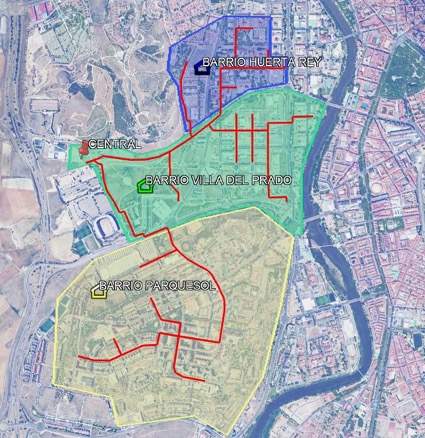
The new project will supply heating and hot water to more than 10,200 homes and 67 commercial buildings, eliminating more than four hundred fossil fuel boilers and chimneys.
In this way, the consumption of 11,224 tons of imported oil equivalent will be avoided each year, replaced by 50,000 tons of locally sourced wood chips. Users will save between 30% and 50% on their energy bills, and the emission of 31,300 tons of CO2 will be prevented.2 equivalent to the year.
The works will begin in the summer of 2022 and commissioning is planned for the 2023-2024 heating season, although buildings will be able to start managing their connection from July of this year.
A self-consumption photovoltaic solar installation and a 6,000 cubic meter sensible heat storage system will also be built to accumulate renewable thermal energy at night.
Biomass will help Valladolid achieve climate neutrality by 2030, according to its mayor. The new facility will be Valladolid's third major network, making it the city with the most biomass-fueled district heating networks in Spain.
The other two major networks are those serving the University of Valladolid campus and the University Hospital, and the one supplying the northeast area of Huerta del Rey. Once completed, the "Valladolid West" network will be hydraulically interconnected with the latter to increase its supply capacity. .
The project is being promoted by the Public Infrastructure and Environment Company of Castile and León (Somacyl). The city council has provided the land where the plant will be located and has expedited the administrative procedures. The planned investment amounts to 30 million euros.
Fountain
https://www.valladolid.es/es/actualidad/noticias/valladolid-ciudad-espana-redes-calor-biomasa
More information about the tender